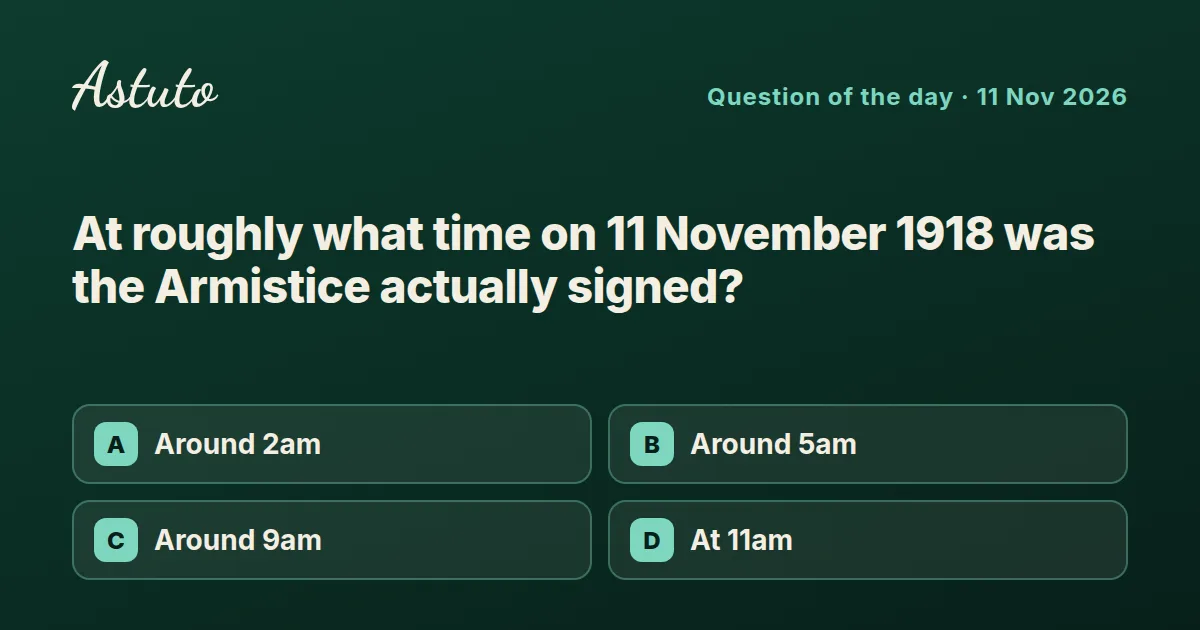
At roughly what time on 11 November 1918 was the Armistice actually signed?
Show the answer
Around 5am
The Armistice was agreed at 5am, with signatures made by about 5.45am Paris time, in a railway carriage in the Forest of Compiègne. It took effect six hours later, at 11am.
Lives were still lost that morning: the last British soldier to die, George Edwin Ellison, was killed near Mons at about 9.30am.
The agreement that ended the fighting was signed in a railway carriage. The German delegation was taken to a secret location aboard Marshal Ferdinand Foch's private train, parked in a railway siding in the Forest of Compiègne, near the town of Compiègne. The armistice was agreed at 5am on 11 November 1918; accounts differ, but the signatures were made from 5am to 5.45am Paris time. Foch, the Allied supreme commander, signed with Admiral Rosslyn Wemyss, the British representative, while the German signatories included the civilian politician Matthias Erzberger. The ceasefire took effect at 11am Paris time, noon in Berlin, which is why the moment is remembered as the eleventh hour of the eleventh day of the eleventh month. Lives were still lost in the hours that followed the signing. George Edwin Ellison of the 5th Royal Irish Lancers, the last British soldier to die, was killed near Mons at about 9.30am, and the Canadian George Lawrence Price was shot about two minutes before the armistice took effect. The armistice was later prolonged three times while peace negotiations continued.
Five questions. Two minutes.
Your turn.